
Jiangfan Li
Thursday, September 1, 2022 | 3 minutes
Fixed-base Manipulator Throwing
Sep 2022 - Jan 2023
at Learning Algorithm and System Laboratory(LASA), EPFL
In short
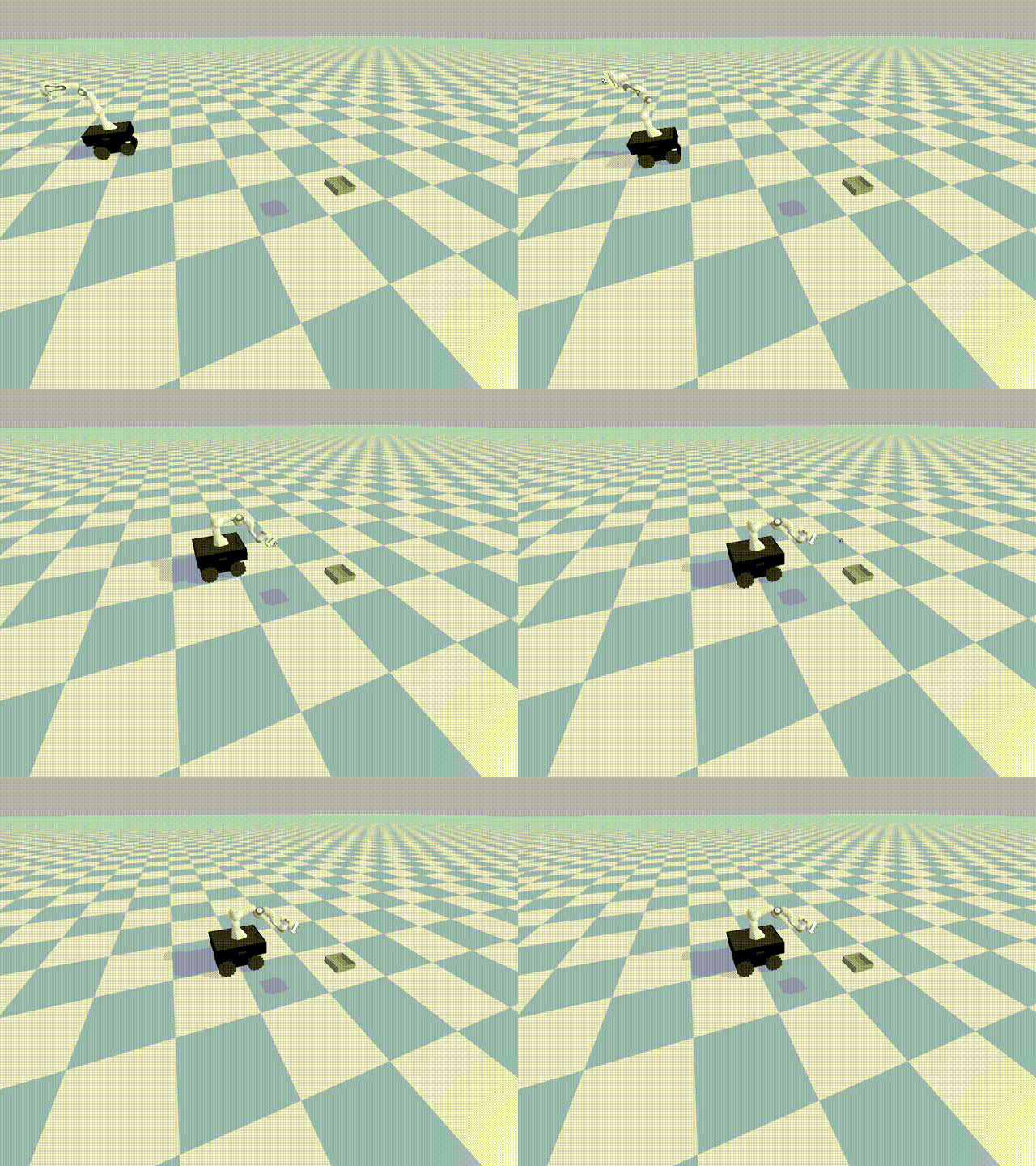
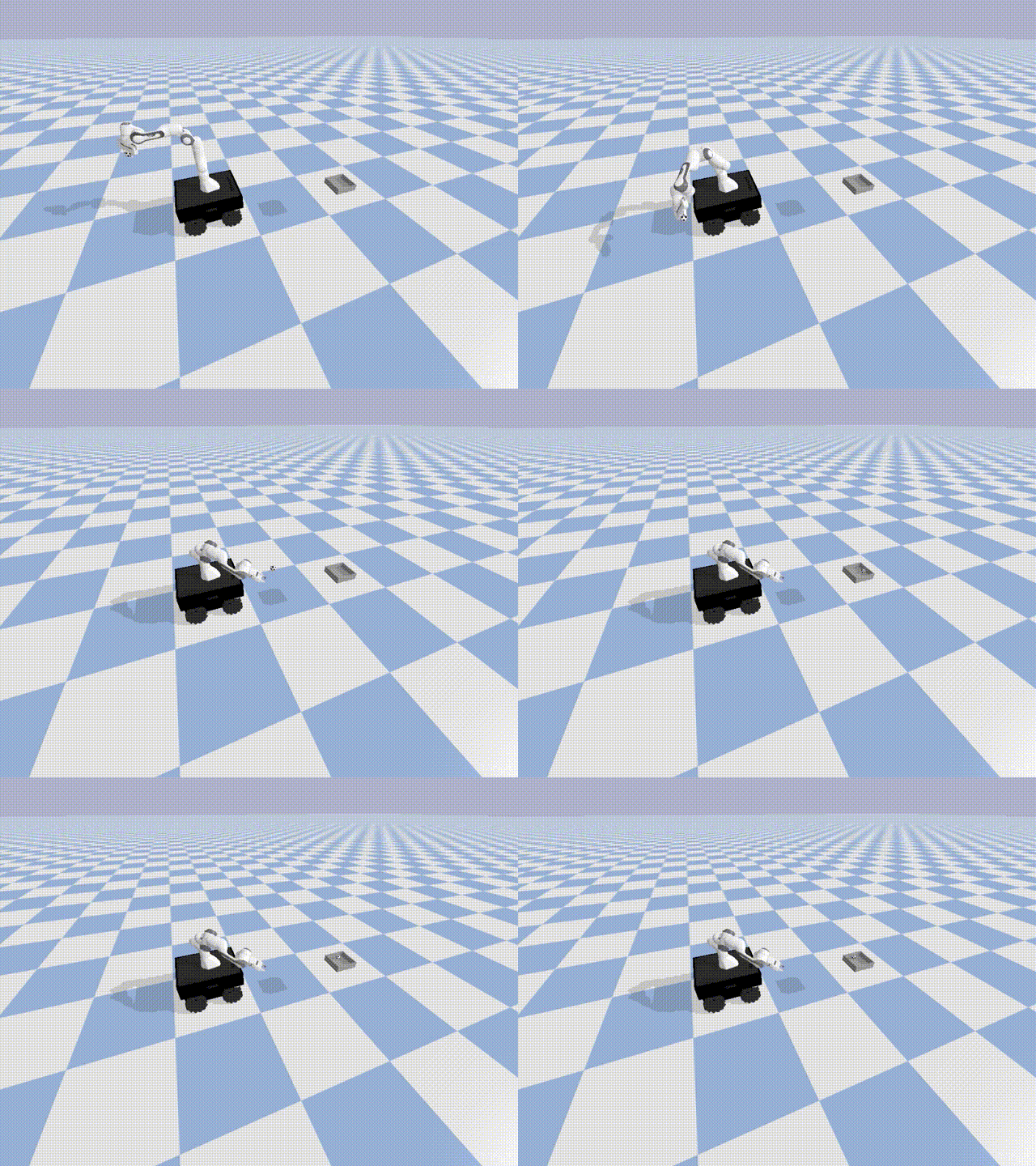
- Adapted current mobile-base solution to fix-base manipulators and accelerated the algorithm
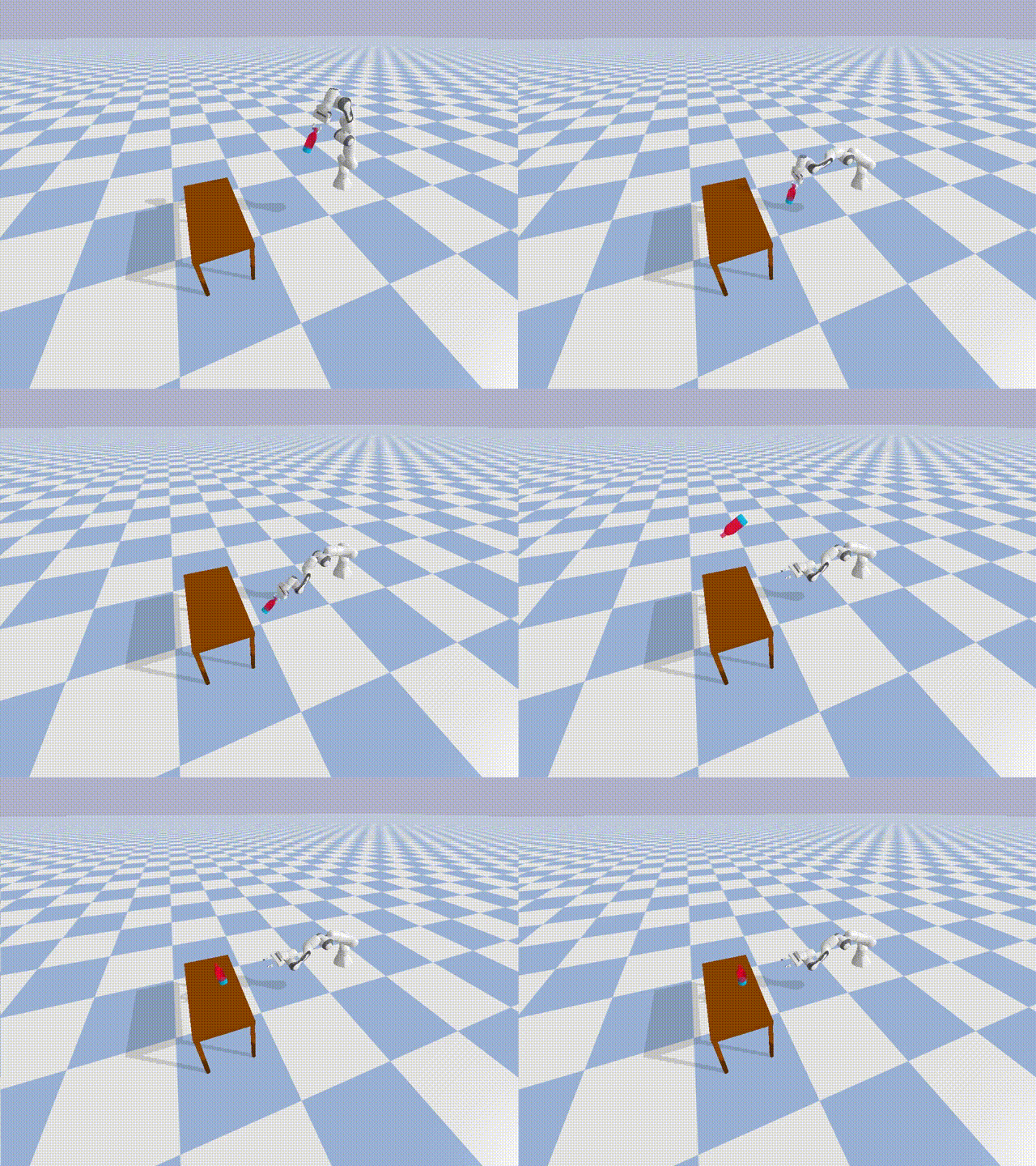
- Explored the bottle flip change with a robot arm(FRANKA EMIKA Panda)
Mobile Base
Fixed Base
Bottle Flip
For more detail
Introduction
Throwing is a dynamic manipulation strengthening a given robotic manipulator by causing motions outside its workspace [4]. This ability is highly desirable for industrial applications. However, because of the nonlinear relationship between robot joint space and throwing task space, throwing problems are generally difficult to solve efficiently.
As a bridge between joint space and task space, velocity hedgehog [3] is a hedgehog-shaped data structure that was proposed for dynamic manipulation tasks, e.g. robotic throwing. It stores a dictionary of appropriate robot joint configurations that can generate high Cartesian velocity along query direction under limited joint velocity for throwing. Combining with an online search algorithm, feasible and valid throwing configurations for mobile manipulators can be generated efficiently.
The existing algorithm heavily relies on the spatial invariance property of the mobile manipulator’s omnidirectional wheel and planar flying dynamics of a point mass. Under these assumptions, the mobile manipulator throwing problem can be described by a compact set of independent variables, and hence the size of velocity hedgehog is manageable and efficient algorithm can be devised.
However, for the sake of generic robotic throwing, the assumptions need to be relaxed and the set of independent variables in order to describe the throwing system will inevitably be enlarged. For example, for fixed-based manipulator throwing, to account for the lost spatial invariance of the mobile base, a naive extension based on the current method would add two extra keys to the dictionary, representing the end-effector’s horizontal positions. In this way, the throwing dictionary would be indexed by a 5-dimensional mesh (instead of a 3-dimensional one in the mobile manipulator throwing case). As the size of the velocity hedgehog and hence the online query time depends exponentially on the number of indexes. Higher dimensional velocity hedgehog, brought by more generic throwing problems, might lose the intended computational efficiency. In order to investigate the applicability of velocity hedgehog for more general throwing setups, in this work, we focus on the following problem: Throwing a point mass to desired position with a fixed-base manipulator Alongside solving this problem, we also contribute to proposing a better strategy for online velocity hedgehog matching, which speeds up the online solver 24 times.
Furthermore, we analyze the throwing problem with constraints on landing orientation and propose a solution with ideal settings.
In the following pages, this report will first introduce the throwing problem and explain the original solution [3] for the mobile manipulator in chapter 1. Chapter 2 shows how this solution adapts to the fixed-base manipulator. Utilizing the fact that the first joint of the Panda manipulator is vertical, only one extra key representing the end-effector’s distance to the base is added upon the solution for mobile manipulation throwing as done in [3]. Despite this insight, the enlarged hedgehog of the fixed-base case with one extra dimension results in a higher computational cost. Trying to address this issue, in chapter 3, two methods for algorithm acceleration are applied and compared. Finally, a more difficult task of throwing towards desired landing orientation is investigated in chapter 4.
The project code is avaliable on Github https://github.com/RLi43/mobile-throwing. The code for chapter 2 and chapter 3 is in default branch fixed-base, and the code for chapter 4 is in branch orientation.
[3] Yang Liu, Aradhana Nayak, and Aude Billard. “A Solution to Adaptive Mobile Manipulator Throwing”. In: arXiv preprint arXiv:2207.10629 (2022).
[4] M.T. Mason and K.M. Lynch. “Dynamic manipulation”. In: Proceedings of 1993 IEEE/RSJ International Conference on Intelligent Robots and Systems (IROS ’93). Vol. 1. 1993, 152– 159 vol.1. DOI: 10.1109/IROS.1993.583093
comments powered by Disqus